

Governments maintain control over more than two-thirds of global forest area, much of which is claimed by local communities, RRI said in a report this month.

RECENT ARTICLES
Locally controlled forest enterprises are the whole enchilada
Mexico’s forests laws mean that 80% of its forests are owned by communities; the country has more than 3,000 community forests in total. Under the watchful eye of Monte Alban, from where the ancient Zapotecs once ruled, experts from 17 countries agreed to form a coalition that builds support for locally-controlled forest enterprises and increases collaboration between support agencies.
Research Finds Collective Forestlands Key to Meeting Climate Mitigation Targets
“If appropriately leveraged, natural climate solutions can contribute upwards of 37 percent of cost-effective CO2 mitigation by 2030 and evidence shows Indigenous Peoples and local communities are key to achieving such outcomes.” This is one of the key conclusions from the global baseline study described as “the most comprehensive assessment to date of carbon storage in documented community lands worldwide.”
Philanthropic groups siphon US$459 million to protect forests, indigenous peoples
A recent study released by Washington-based research coalition Rights and Resources Initiative showed that indigenous peoples and local communities across the globe owned at least 418 million hectares, 15.2 percent of the forestland in the regions.
Fight climate change by granting indigenous rights to forests: report
Granting forest dwellers legal rights to their traditional lands helps fight deforestation and climate change, but the vast majority of the world’s forests remain under government control with limited access for communities, researchers said. Only about 14 percent of forests, or about 527 million hectares, were legally owned or designated for local communities in 58 countries surveyed by the Rights and Resources Initiative (RRI), a Washington D.C.-based advocacy group.
Criminalization and violence increasingly used to silence indigenous protest, according to UN report
The NGO Rights and Resources International (RRI) estimates that indigenous peoples have legally recognized rights to just 10 percent of the world’s land, though they control as much as 65 percent through customary, community-based tenure systems. Anne-Sophie Gindroz, RRI’s facilitator for South East Asia, said that the law isn’t only failing indigenous communities when it comes to awarding them title to their traditional lands.
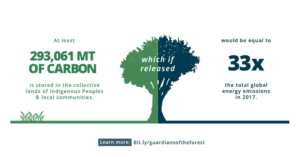
New analysis: Indigenous Peoples and Local Communities protect 5 times more carbon than previously thought
Two new studies released on the eve of the Global Climate Action Summit illustrate the powerful links between securing indigenous and community land rights and protecting the forests that are vital to mitigating climate change. As climate researchers, advocates, and leaders gather in California this week to discuss priorities and goals at the Global Climate Action Summit, they must recognize the urgent need to secure the rights of Indigenous Peoples and local communities as a key climate solution.
Estimate of carbon in indigenous lands rises five-fold
Land managed by indigenous people holds vastly more carbon than previously thought, according to a report that calls for an urgent strengthening of their land rights to avoid its release into the atmosphere. But while communities have succeeded in securing governmental recognition of their forest rights for 15 per cent of forests globally, the pace of recognition since 2008 has decreased, according to the Rights and Resources Initiative (RRI), the organisation behind a second report.
Climate mitigation has an ally in need of recognition and land rights: indigenous peoples in tropical countries
The study, led by Rights and Resources International (RRI), found that indigenous peoples are far better stewards of the land than their countries’ governments.
Estimate of carbon in indigenous lands rises five-fold
While communities have succeeded in securing governmental recognition of their forest rights for 15 per cent of forests globally, the pace of recognition since 2008 has decreased, according to the Rights and Resources Initiative (RRI), the organisation behind a second report.

New analysis reveals that Indigenous Peoples and local communities manage 300,000 million metric tons of carbon in their trees and soil—33 times energy emissions from 2017
New analysis reveals that Indigenous Peoples and local communities manage 300,000 million metric tons of carbon in their trees and soil—33 times energy emissions from…

In DRC, a network of women leaders successfully advocated for an unprecedented legal framework to secure women’s land and forest rights
In the Democratic Republic of the Congo (DRC), Indigenous Peoples, local communities, and rural women have long struggled to have their customary rights to their lands and forests formally recognized—but a breakthrough in one province shows that this could be changing at a pivotal moment.
The Most Read Stories


Subscribe to the Gender Justice Digest
to receive new articles directly in your inbox
Subscribe Now!