

If properly leveraged, natural climate solutions can contribute over 37% of cost-effective CO2 mitigation by 2030. Evidence shows Indigenous Peoples and local communities are key to achieving such outcomes. This report presents the most comprehensive assessment to date of carbon storage in documented community lands worldwide.

At a Crossroads: Consequential Trends in Recognition of Community-Based Forest Tenure from 2002-2017
This analysis reports on trends in global forest tenure from 2002-2017. It is the fourth in a series of analyses monitoring the legal recognition of forest tenure around the world.
Despite widespread poverty and insecure resource rights, evidence shows that Indigenous Peoples and local communities are still spending their limited resources on conservation efforts. They are also achieving outcomes that are at least equivalent to those of government-funded protected areas. This brief shows an urgent need to replace the fortress-conservation model with rights-based approaches to both improve conservation outcomes and end human-rights abuses committed in the name of conservation.
The research examined the laws of 100 countries to ascertain the status of lands which social communities, either traditionally or in more contemporary arrangements, deem to be their own.

This brief presents a review of the nominal progress made in the national-level laws and regulations that govern the carbon trade and define the rights of parties—across a sample of 24 countries in Africa, Asia and Latin America. These countries collectively hold more than 50 percent of global tropical and subtropical forests.

This study assesses the cumulative risks and impacts of all REDD+ initiatives in the DRC province of Mai-Ndombe on the rights and subsistence of local communities and Indigenous Peoples. Using existing tools while taking into account gray areas in the REDD+ process, the study maps all existing and planned REDD+ initiatives in the province.
This brief highlights key attributes of national constitutions, laws, and regulations that play a fundamental role in protecting indigenous and rural women’s rights to community forests and other community lands. These legislative best practices were derived from a 2017 analysis of over 400 national laws and regulations, Power and Potential, which evaluates the extent to which women’s rights to community forests are recognized by national law in 30 low- and middle-income countries (LMICs) across Africa, Asia, and Latin America.
The purpose of this report is to situate existing knowledge on First Nation-held forestry tenures and community forest enterprises (CFEs) in British Columbia, Canada within a broader discussion about Indigenous and non-Indigenous community forests in Canada.

Drawing on international standards and Green Climate Fund policy documents, this report traces the adequacy and implementation effectiveness of the Fund’s current institutional frameworks across a representative sample of approved projects. Noting critical gaps in nearly every aspect of the Fund’s operational modalities and project approval processes, the report calls on the GCF to take progressive steps to make Indigenous Peoples’ and local communities’ rights a key part of its climate actions going forward.

This report discusses the critical role of Indigenous Peoples and local communities in the context of emerging climate and development priorities, and the unprecedented opportunity to scale up the recognition and protection of community land and resource rights—both for the benefit of rural peoples and for the realization of global peace and prosperity.
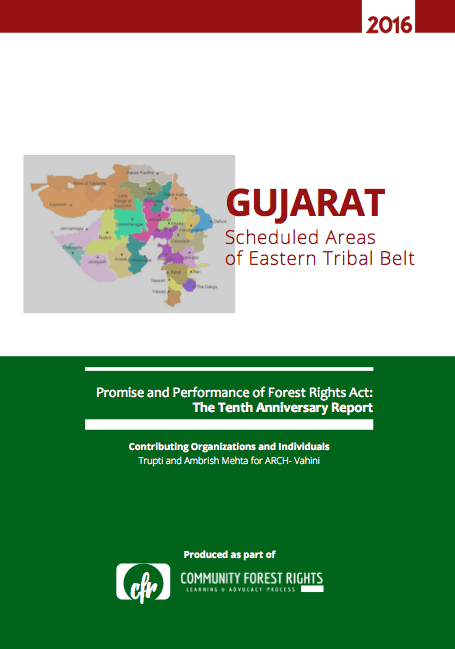
This study gives an approximate estimate of the potential forest areas that can be covered under the FRA in Gujarat. The idea is to compare and assess the actual status of the implementation with regards to the potential. This study also provides an overview of the implementation of the Act, together with highlights of both positive and negative aspects of the process and outcomes.

This study makes a preliminary assessment of the potential forest area over which rights can be recognized in Telangana under the FRA and compares it with the actual performance. The estimate provided offers a baseline for informing implementation, planning, and setting targets for rights recognition under the FRA.

This study makes a preliminary assessment of the potential forest area over which rights can be recognised in Odisha under the FRA. The estimate offers a baseline for informing implementation, planning, and setting targets for rights recognition under the FRA.
This paper proposes a framework of analysis to systematically classify and evaluate legal pathways to secure recognition of community-based property rights.
This report synthesizes research findings on gender dynamics and the implications for gender justice in community-based tenure systems in Zambia and Bolivia.

A new analysis from RRI provides an unprecedented assessment of legal frameworks regarding indigenous and rural women’s community forest rights in 30 developing countries comprising 78 percent of the developing world’s forests.

A study found that the impact of large scale land acquisitions has caused women to lose their rights to use, access and own land for housing or farming, forest and forest products as well as other natural resources in their communities.

Amid the realities of major political turbulence, there was growing recognition in 2016 that community land rights are key to ensuring peace and prosperity, economic development, sound investment, and climate change mitigation and adaptation.

A synthesis of an investigation of tenure risk in East, West, and Southern Africa, that shows that a majority of tenure disputes are caused by the displacement of local peoples, indicating that companies and investors are not doing enough to understand competing claims to the land they acquire or lease.

Disputes over land and resource rights create operational and reputational risks through delays, rising costs, and curtailed access to finance and markets.

An empirical picture of the causes and effects of tenure-related disputes between private sector actors and local peoples across different sub-regions and countries in Africa, this analysis details statistical evidence of key trends in tenure-related disputes, including their causes as well as the prevalence of violence, work stoppages, and regulatory interventions.

Tenure disputes in Southern Africa have created financial and reputational damage for the companies and investors involved.

This paper examines recent case studies of tenure-related dispute in East Africa to help companies, investors, governments, and CSOs avoid and resolve them more effectively.

This report highlights FRA’s potential in transforming forest governance by empowering local communities and the gram sabha to protect and conserve forests; ensuring livelihood security and poverty alleviation; securing gender justice; meeting SDG, especially the goals of eliminating poverty and achieving ecological sustainability; and dealing with climate change.